
Past Exhibition: “Scott’s Last Expedition” at the Natural History Museum in London
Past exhibition: “Scott’s Last Expedition” at the Natural History Museum in London ran from January 2012 to September 2012. The original article was first posted in June 2012 and amended in May 2026.
When Captain Robert Falcon Scott embarked upon the Terra Nova expedition to Antarctica and the South Pole in 1910, he took with him two HMV ‘Monarch Gramophones’, loaned by The Gramophone Company, and several hundred 78rpm shellac discs specifically chosen to boost the team’s morale.
At the time of the expedition, The Gramophone Company was still very young, but the management team recognised the huge marketing and promotion potential in aligning The Gramophone Company with the expedition. Captain Scott and his fellow naval officers invested a lot of time into fundraising and generating support for the expedition among the press, industry and the public, as this extract from a fundraising leaflet clearly shows.
“The main object of this expedition is to reach the South Pole and to secure for the British Empire the honour of that achievement.“
As a result, the expedition was sponsored by many leading companies of the time. On previous trips to the Antarctic, a piano had been taken; however, none of the officers on this expedition was accomplished players, so instead they carried with them a Pianola (a self-playing piano) and the HMV Monarch Gramophone. The crew knew that they would be spending 2 years isolated from the rest of civilisation; therefore, music was a vital connection to the rest of the world. During the long, dark Antarctic winter, the Gramophone was only played at specific times once a day; keeping a strict timetable allowed the men to maintain normal circadian rhythms despite the lack of sunlight to dictate night and day.
The 25 men on the expedition who shared the hut at base camp played a carefully chosen selection of music, which included pieces that represented the different members of the team. Including Norwegian music, folk music, spoken word, comedy, as well as popular classics from the music superstars of the era, such as Enrico Caruso and Clara Butt.
Many of these recordings can be found on our ‘Scott’s Music Box’ CD compilation album. This album contains 48 of the tracks that are known to have been played during the expedition, according to Scott’s diaries and those of his fellow officers and scientists. ‘Scott’s Music Box’ is a collaboration between the EMI Archive Trust, EMI Records and Abbey Road Studios. This double CD is available for purchase here
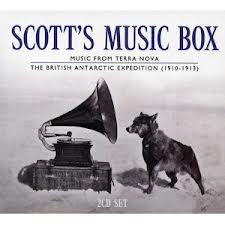
Pictured: ‘Scott’s Music Box‘:‘ A selection of recordings played, and recordings likely to have been played on Captain Robert Falcon Scott’s fateful last expedition to the South Pole.
Upon the return of the men, the whole of Britain and indeed the world was captivated by the incredible bravery and tragedy of the men who set out on that expedition. The Gramophone Company released special edition records in memory of the death of Captain Scott and his men.
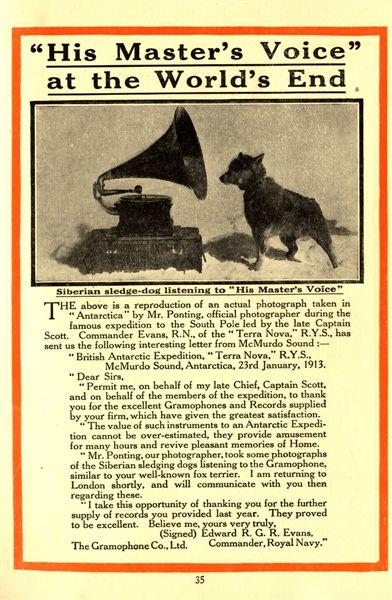
Pictured: A published letter from Admiral Edward Ratcliffe Garth Russell Evans, 1st Baron Mountevans (1880–1957), known as “Teddy” Evans, 23 January, 1913, Gramophone Company Sales Catalogue
After the expedition, the Gramophone was returned to The Gramophone Company and is still held within the archive collection today. 2012 commemorated the 100th anniversary of the death of Captain Scott. The EMI Archive Trust worked with The Natural History Museum on an exhibition to observe that great Journey. The exhibition saw this Gramophone and other artefacts from major institutions and private collections from the Tera Nova Expedition travel from the Natural History Museum in London, to Australia, and finally Canterbury Museum in New Zealand.
Scott’s Gramophone has been safely returned to the EMI Archive in Hayes. It is in excellent condition and remains one of our most prized pieces.
Main image: The original HMV Monarch Senior Gramophone, loaned by the Gramophone Company, courtesy of the EMI Archive Trust collection.
This is a past exhibition that ran from 2012 to 2015